
When Seeing Was More Than Sight
A Psycho-Oncology Narrative
Ms Alisha Karim, Varanasi
How She Got Here
The diagnosis came late and came hard. In December 2025, a brain lesion was read as tuberculoma. Anjali started anti-TB treatment. She was on it for months. Then she began coughing up blood. Bronchoscopy. Biopsy. And then the actual diagnosis: metastatic adenocarcinoma of the left lung, already in the brain, lymph nodes, adrenal glands, bones, soft tissue. The cancer had been there the whole time.
By March 2026, her PET-CT showed how far it had spread. Chemotherapy was started. Whole-brain radiotherapy followed. After the third session, she lost her vision completely. Not blurring. Not partial. Gone. No light, no colour, nothing. Treatment started to regain vision. But no one could tell her it would come back.
That was the situation when she was referred to me.
The First Session

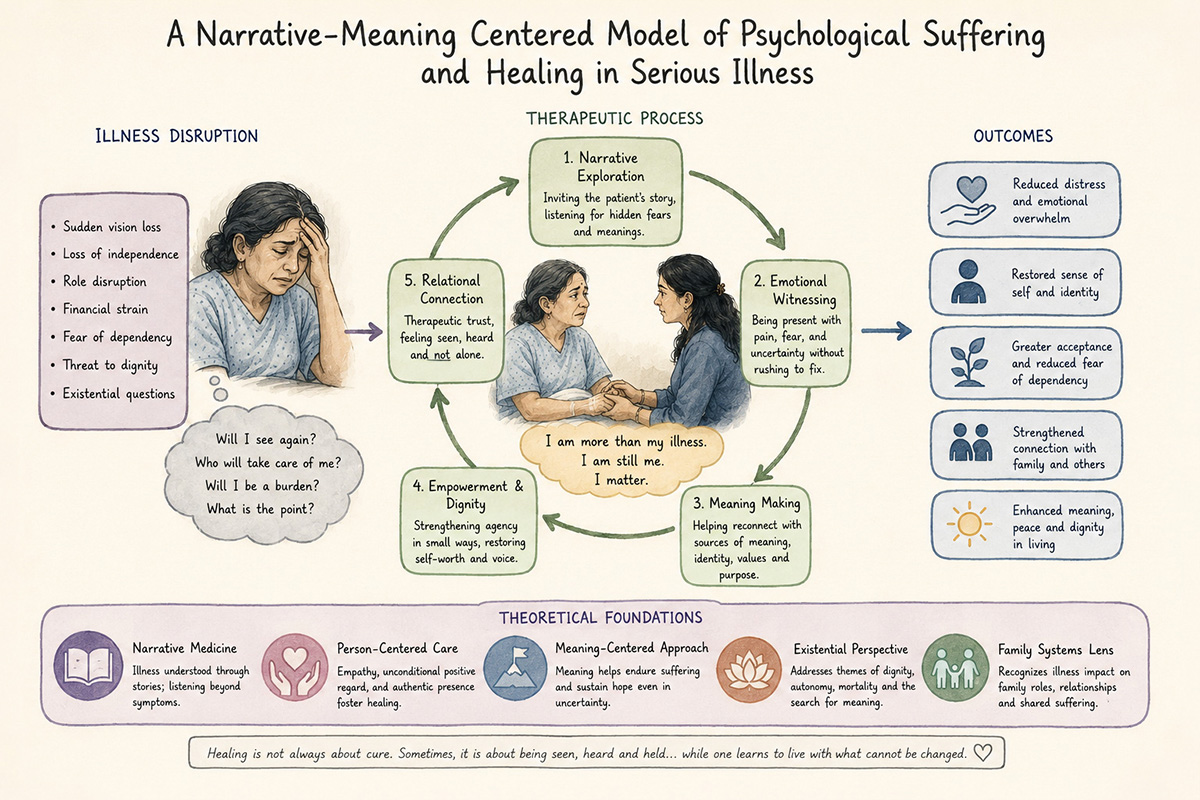
She was sitting up when I came into the room her fingers moving along the edge of her bed sheet. She was feeling her way. The hospital ward was loud with all the machines beeping and people walking around. It was like any ward with families visiting and monitors making noise. She looked really alone in the middle of all this.
She turned to face me before I even said hello.
Soon as I introduced myself f she asked me:
“Will I be able to see again, Madam?”
I did not give her any false hope because I just did not have it. I told her what the doctors had already told her. That the treatment was going on. There were no guarantees. Then I just sat there with her. I did not try to change the subject or move on. I have learned that sometimes we clinicians try to fill the silence because it makes us uncomfortable not because it helps the patient.
When I asked her what was worrying her the most, she did not talk about the cancer. The First Session with her was becoming more about her life. She talked about having to depend on people for everything. She talked about losing the ability to do things on her own. She had always been an independent woman running her own restaurant and managing a kitchen from home. She would wake up early every day to c0ok. Now she needed help with everything.
Anxiety about her vision was actually something deeper. It was about her dignity. It was about the person she had become over the fifty years. The cancer, the treatment, and the loss of vision were all taking a toll on the life she had built for herself, on the person she was, and on her dignity.
Her baseline assessment reflected significant psychological distress, with a GAD-7 score of 16, a PHQ-9 score of 16, and a Distress Thermometer score of 8.
What the Kitchen Was Really About
It took me a few sessions to understand what the kitchen meant to Anjali.
She ran a family restaurant and a cloud kitchen from her home.
She told me about the mornings, the masalas, and teaching her daughter-in-law how to get the spice blend right.
When Anjali talked about the kitchen, something in her would relax.
I said to her, “You come alive when you talk about the kitchen.”
She was quiet for a moment. She smiled! It was the first time I had seen her smile.
Anjali said, “The kitchen was my world. Everything has stopped now.”
Her daughter-in-law was managing the household while caring for Anjali. The Zarit Burden Interview showed mild-to-moderate caregiver burden.
Anjali kept saying, “I have always helped others. Then why do I have to go through this?”
I did not have an answer. I was not going to pretend that I did.
Anjali was mourning things that had not completely gone yet.
When you are very sick, you do not just worry about dying; you also worry about losing the person you are. That was what was happening to Anjali. She was not scared of dying. What she was really scared of was becoming someone nobody would recognize as Anjali.
One day, when we were talking, Anjali said something that really stuck with me.
She said, “Death is better than this.”
She did not say it in a dramatic way. She just said it like she was really tired.
I asked her what she meant by that. She told me that she was tired of having to depend on people all the time. She was tired of watching her family have to put their lives on hold to take care of her.
I did not try to tell her that she was wrong.
I just let her say what she was feeling.
Then I asked her, “Is there anything, even something small, that still feels like it belongs to you?”/p>
We sat there in silence.
Then she said, “Talking. When I talk about the kitchen, I forget my illness for a little while.”

Staying Without Promising
Several sessions in, she reached out and held my hand.
She said “Do anything, I just want my vision back.”
I held her hand. I said “I hear you, I really wish I could give you that.”
I could not tell her that she would be able to see one day. At that moment, I could stay with her, and that is what I did.
This does not mean accepting things and being okay with them.
It means finding a space between her and her fear. Just enough space to breathe.
The hardest moments weren’t when she cried. They were when she went quiet, holding the edge of her blanket in both hands, saying nothing. Those silences needed sitting with, too.
What Changed and What Didn’t!
The GAD-7 score decreased from 16 to 9 by the final counselling session. The PHQ-9 score decreased from 16 to 12 and further decreased to 3 by the time of discharge.
When I first met Anjali, she would start talking as soon as I walked in. She would talk fast. She would hardly stop. It was like she was trying to avoid silence. That changed over time.
She started waiting for me. Her son once told me with a smile that she would ask every morning what time I would arrive. I had read about what makes therapy work from Rogers. It is about being present and consistent. I think that is what Anjali needed most.
The sessions got quieter. There were crises and more conversations. She would talk about recipes she had perfected over the years. She would talk about customers she still remembered by name. She would talk about the noise of the restaurant during festivals. I would ask her questions. I wanted to hear her stories. Her illness had made her feel that she was becoming nothing more than a diagnosis to others. But talking about the kitchen helped her fight against that.
During one session, she cried properly. Her son, who had been holding it together for weeks, cried quietly too. What came after was not sadness. It was different. It was lighter.
“When you sit here, my mind becomes less restless,” she said.
The Last Question
Before she went home, she asked me something that caught me off guard.
“Do people get used to living with these fears?”
I did not reply right away. I wanted her question to sink in for a moment.
Then I told her, “Yes.”
It does not happen quickly. It is not easy. Yes. The fear is still there. However, it stops controlling your life. Your mind, which is working hard at this moment will eventually find a more stable pace. It will learn to deal with the fear without being controlled by it.
I explained to her that needing help does not mean she is losing herself. The woman who had spent her life cooking for others and making sure no one went hungry was still the same person. Her kitchen was quiet at that moment. The things she had built there, the knowledge, the recipes, the way her family knew how to work together in the kitchen, were all because of her. Those things were still there. Her illness had put her life on hold. It had not erased everything she had done.
“I had not thought of it that way ” she said.
As I stood up to leave, she turned towards the sound of my footsteps.
“Madam you will come back tomorrow, right?”
I said, “I will …”
Medicine tracks healing through symptoms and outcomes. But individuals go through much more than physical symptoms when they are sick. They grieve the life they once had. When Anjali asked, “Will I see again?”, she was not just talking about her eyes. For Anjali, it was about being able to feel good about herself. It was about being the person she knew.
When illness takes away the things through which someone has always known who they are, the work is not to minimise that loss. It is to sit beside them honestly and help them find, in what remains, enough ground to stand on.
About the Author:

Ms Alisha Karim is a Clinical Psychologist currently working in the Department of Psycho-Oncology at the Mahamana Pandit Madan Mohan Malaviya Cancer Centre (MPMMCC), Varanasi, a unit of the Tata Memorial Centre, Mumbai.